

Investigating Elastomeric Materials Under Dynamic Conditions
Why Natural Frequency Testing Matters
Elastomer performance is often evaluated using static material properties such as tensile strength, elongation, and hardness. While these metrics provide useful baseline data, they do not capture how materials behave under real operating conditions.
In many applications, elastomers are subjected to cyclic loading, vibration, and frequency-dependent deformation. As a result, performance is governed by viscoelastic behavior, not just static properties.
This article outlines why dynamic mechanical testing of elastomers, particularly at natural frequency, is essential for accurately understanding and optimizing elastomer performance.
Limitations of Conventional Testing
Traditional testing methods focus on quasi-static conditions and typically measure:
- Tensile strength
- Elongation at break
- Hardness
These values describe material limits, but they do not provide insight into:
- Energy dissipation during cyclic loading
- Damping performance
- Frequency-dependent stiffness
- Heat buildup and fatigue behavior
This gap often leads to discrepancies between lab results and real-world performance.
Understanding Viscoelastic Behavior
Elastomers exhibit both elastic and viscous responses under load.
- Elastic response (storage modulus, E’): Energy stored and recovered
- Viscous response (loss modulus, E’’): Energy dissipated as heat
The relationship between these responses is expressed through:
- Loss factor (tan δ)
- Phase angle between stress and strain
- Hysteresis behavior (energy loss per cycle)
These parameters directly influence how a material performs in applications involving vibration, shock absorption, and repeated loading.

Why Natural Frequency Matters
Elastomer behavior is strongly dependent on frequency.
Testing at or near a system’s natural frequency:
- Captures resonance effects
- Highlights differences in damping behavior
- Reflects real service conditions
Testing outside of this range can overlook critical performance characteristics, particularly in vibration-sensitive applications.
Dynamic Mechanical Testing of Elastomers: What It Reveals
Dynamic mechanical evaluation provides insight into properties that static tests cannot capture, including:
- Hysteresis: Energy loss during loading and unloading cycles
- Damping (tan δ): Ability to reduce vibration
- Dynamic modulus: Stiffness under cyclic loading
- Energy absorption and return: Key for resilience and isolation
These properties are essential for applications such as:
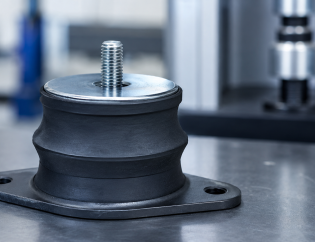
- Vibration isolators
- Automotive components
- Rail systems
- Industrial machinery
- Structural damping systems
Impact of Formulation and Processing
Material performance is highly sensitive to formulation and processing conditions.
Studies on peroxide-cured phenyl-vinyl-methyl-polysiloxane (PVMQ) elastomers demonstrate that:
- Co-agents and radiation can alter crosslink density and network structure
- These changes significantly affect:
- Damping behavior
- Resilience and energy return
Importantly, these effects are most clearly observed under dynamic testing at natural frequency, reinforcing the need for appropriate evaluation methods.
From Data to Decision-Making
Dynamic mechanical data enables more precise engineering decisions, including:
- Optimizing formulations for specific performance targets
- Tuning damping versus resilience characteristics
- Reducing trial-and-error during development
- Improving consistency between lab and field performance
This shifts testing from simple validation to predictive optimization.
Measurement Approach
Accurate dynamic evaluation requires:
- Controlled loading in compression or shear
- Simultaneous measurement of force and displacement
- Analysis of phase relationships between stress and strain
- Testing across relevant frequency ranges
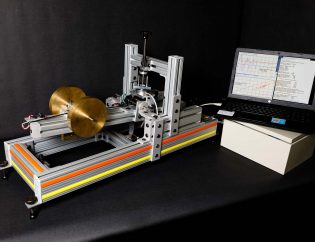
Dynamic mechanical systems, such as the DMYO-V Yerzley Oscillograph, are designed to provide this level of insight by:
- Measuring hysteresis behavior directly
- Calculating dynamic and point moduli
- Determining damping characteristics and natural frequency response
Conclusion
Static properties describe what a material is.
Dynamic properties describe how it behaves.
For elastomer applications involving vibration, cyclic loading, or energy dissipation, performance is governed by frequency-dependent viscoelastic behavior.
Evaluating materials under dynamic conditions, particularly at natural frequency, provides a more accurate and actionable understanding of performance.
Supporting Research
"Dynamic Mechanical Properties of Radiation-Modified Peroxide-Cured PVMQ Elastomers at Their Natural Frequency", published on KGK Rubberpoint
This study demonstrates how formulation and radiation influence damping and resilience in silicone elastomers and highlights the importance of dynamic testing at natural frequency for accurate performance evaluation.